Choosing between a smooth or textured drywall finish affects how a room looks under different lighting, how easy it is to maintain, and what repairs will cost down the line. Neither finish is universally better. The right choice depends on the room, the lighting conditions, and how the space will be used. Select Drywall System’s taping and texture services cover both finishes across Edmonton, so the decision comes down to what suits the project, not what the crew is limited to.
Appearance and Lighting Impact
Finish choice and lighting conditions interact directly. The same wall can look clean and refined or visibly imperfect depending entirely on where light hits it and at what angle.
How Smooth Finishes Highlight Imperfections
A smooth finish reflects light evenly, which makes any variation in the wall surface visible. Joints, fastener dimples, slight crowning, or tool marks that would disappear under texture become apparent under a smooth finish, especially in rooms with strong directional lighting or large windows. This is not a defect of smooth finishing as a system. It is a physical property of flat, reflective surfaces.
Achieving a true smooth finish requires a Level 5 finish: a skim coat of compound applied over the entire surface after taping and sanding. This eliminates the surface porosity differences between the paper face of the drywall and the compound at joints, which would otherwise read differently under sheen paint. Applying semi-gloss or satin paint over anything less than a Level 5 finish on smooth walls will reveal every joint and fastener location.
How Texture Diffuses Light and Shadows
Texture creates surface variation that scatters light in multiple directions. The result is that minor imperfections beneath the texture, and even the texture pattern itself, become visually neutral because the eye has no single flat plane to read against. This makes texture significantly more forgiving of substrate irregularities and joint work that does not meet the standard required for smooth finishing.
The degree of light diffusion depends on the texture profile. A light orange peel has minimal effect on light behaviour. A heavier knockdown or stomp texture creates enough surface variation to neutralize most directional lighting effects. Rooms with pot lights, strong natural side-lighting, or large windows benefit most from the diffusing effect of texture.
Maintenance and Repair Considerations
Smooth walls are easier to clean. The flat surface can be wiped down without catching on texture ridges or pushing debris into recesses. This matters most in kitchens, bathrooms, and high-traffic hallways where walls are cleaned regularly.
Repairing smooth walls is more demanding. Any patch must be feathered out, sanded flat, and skim coated to match the surrounding surface. Done correctly, a repair on a smooth wall is invisible. Done poorly, the repair reads as a dull or slightly raised area under certain lighting. The margin for error is narrow.
Textured walls are harder to clean in heavy texture profiles but easier to repair. The repair compound only needs to match the texture pattern, not a perfectly flat plane. Most common textures can be approximated by hand or with a spray hopper, and the surrounding pattern disguises minor variation in the blend. The exception is machine-applied textures with highly consistent patterns, where matching requires the same equipment and settings used in the original application.
Converting textured drywall to smooth later is possible but labour-intensive. Skim coating over existing texture requires either multiple coats to fill and level the profile or, in heavy texture cases, sanding the peaks off before skim coating begins. The cost approaches that of replacing the drywall in rooms with a very heavy texture.
Cost and Labour Differences
Texture generally costs less than a high-quality smooth finish because it requires fewer finishing stages. A Level 4 finish followed by spray texture is faster than a Level 5 skim coat, which requires an additional full-surface pass and extended drying time before sanding and painting.
The cost gap narrows when texture complexity increases. Simple orange peel texture applied by spray is fast. Hand-applied knockdown or custom texture patterns take longer and require skilled application to produce a consistent result across a full room.
Smooth finishing at Level 5 is the most labour-intensive standard finish. It requires tight compound work at the taping stage, because any ridges or high spots become harder to correct after the skim coat is applied. Painters also need to account for Level 5 in their prep, as the skim coat surface requires a primer before topcoats to prevent flashing.
The overall cost difference between a standard texture and a Level 5 smooth finish is meaningful on a whole-home scale. On a single room, the gap is smaller and may not be the deciding factor.
Room-by-Room Suitability
- Living rooms. Either finish work in living rooms. Smooth is the current preference in modern and contemporary interiors. Texture suits traditional styles and older homes where smooth walls would look inconsistent with the rest of the house. Lighting placement matters most here: rooms with wall sconces or raking natural light will show smooth wall imperfections more than rooms with centered overhead lighting.
- Basements. Texture is generally the better choice in basements. Lower ceiling heights make walls more visible at closer range, and basement lighting is often less even than above-grade spaces. Texture is also more forgiving of the minor moisture-related movement that can occur in below-grade walls over time, which can open hairline cracks that read clearly on a smooth surface.
- Hallways. Hallways are high-contact areas where walls get scuffed and marked. Smooth surfaces are easier to clean but show damage more clearly. Light texture hides minor wear and makes touch-up less exacting. Narrow hallways with light sources at one end are particularly unforgiving of smooth surfaces, since light travels along the wall at a shallow angle and reveals any surface variation.
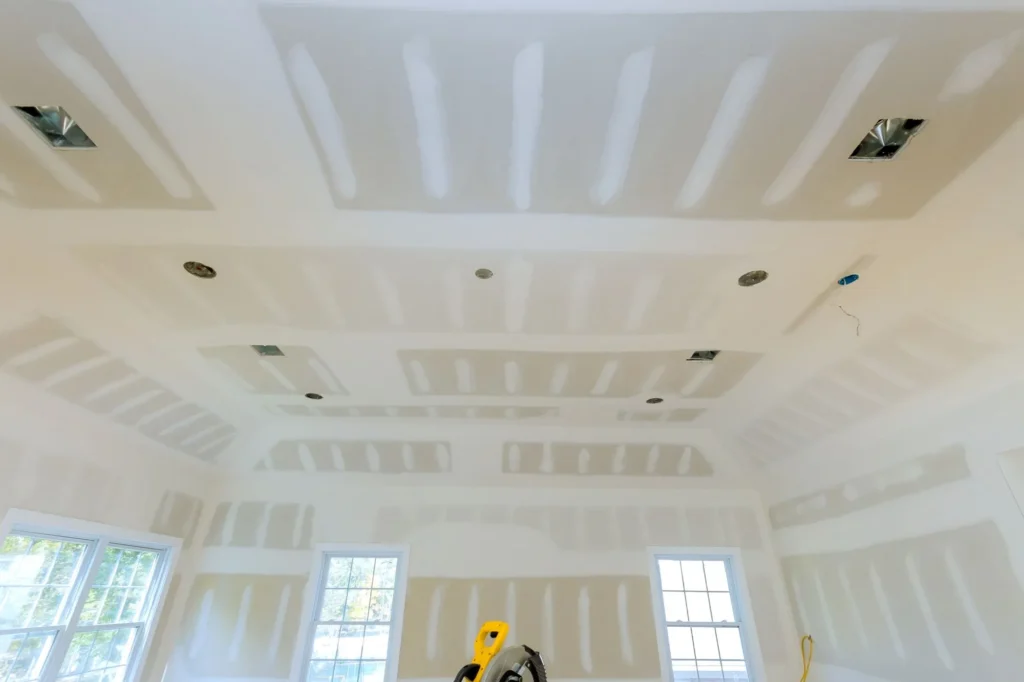
- Ceilings. Smooth ceilings are standard in high-end residential construction but require Level 5 finishing to perform correctly under overhead lighting. Texture is common on ceilings in residential builds because it is faster, costs less, and handles the settlement movement that ceilings experience over time without cracking visibly. Popcorn texture is no longer commonly specified for new work, but orange peel and light knockdown remain standard ceiling texture options.
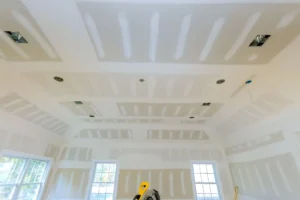
When a Hybrid Approach Makes Sense
Smooth and textured finishes can coexist in the same home when zones are defined by function or style. A common application is smooth walls in main living areas and bedrooms with texture in the basement, garage, or utility spaces. This keeps finishing costs proportional to how much visual impact the surface has in each space.
Accent walls present another hybrid scenario. A single smooth feature wall in a room that is otherwise lightly textured draws attention to that surface and works well behind built-ins, fireplaces, or large artwork where the wall itself becomes part of the design.
The practical limit of hybrid finishing is transition management. Where a smooth surface meets a textured surface at a corner, door casing, or ceiling line, the junction must be detailed cleanly or the contrast reads as unfinished. Inside corners and door frames handle the transition naturally. Butt joints between the two finishes in the middle of a wall do not.
Select Drywall System can assess which finish suits each room in a project and apply both where a hybrid approach makes the most sense.